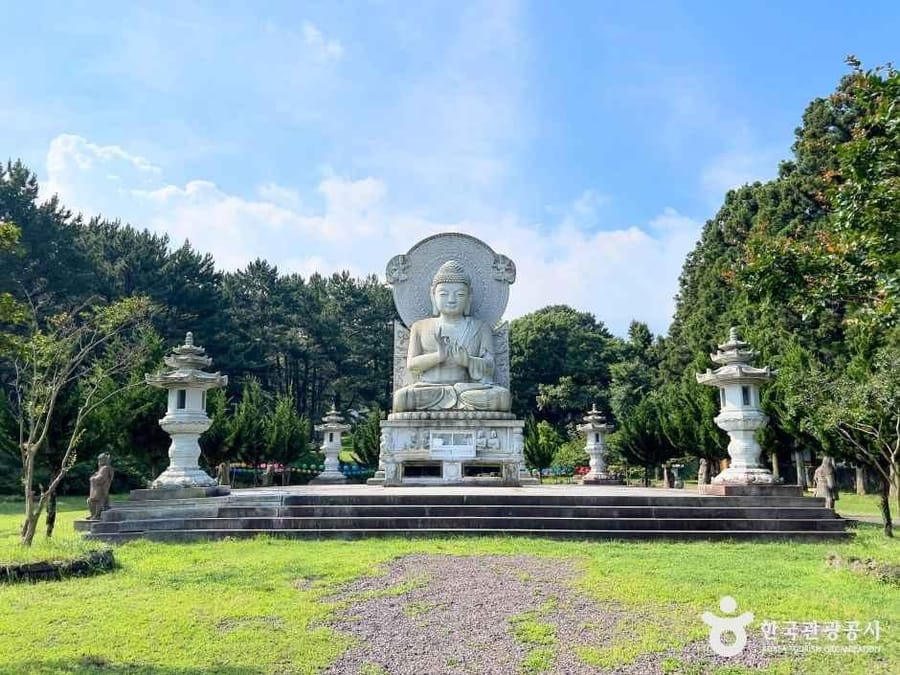
Gwaneumsa Temple (Jeju)
觀音寺- Era
- Founded 1008 · 고려
- Sect
- 조계종
- Feature
- District Head Temple, Thousand-Year-Old Temple
660 Sanrokbuk-ro, Jeju City, Jeju Special Self-Governing Province
Founded 1008 · 고려조계종
0 visitors
Verify your visit to unlock challenges.
Temple information
Gwaneumsa, the head temple of the 23rd district of the Jogye Order of Korean Buddhism, located at the foot of Hallasan Mountain at 650m, is the center of Jeju Buddhism, overseeing over 30 temples in Jeju. The source of its strength can be found in Jeju's Buddhist history. Through various myths, legends, and folk tales of Jeju, it was known as Goenamjeol (Gwaneumsa in Jeju dialect), Gaenamjeol, Donggoenamjeol, and Eunjungjeol. Records of Gwaneumsa remain in a geography book from the reign of King Seongjong of Goryeo, and it is also known to have existed during the Joseon Dynasty. As Joseon honored Confucianism, all temples in the Jeju region, including Gwaneumsa, were demolished by Governor Yi Hyeong-sang in 1702. After maintaining its Buddhist lineage for 200 years, it was rebuilt in 1908 by the Venerable An Bong-ryeo-gwan. Despite facing local opposition, the venerable monk completed the Dharma hall and living quarters by performing Gwan-eum prayers for three years in Haewol-gul Cave. Subsequently, Buddhist statues and Buddhist paintings (tanka) were brought from places like Tongyeong Yeonghwasa Temple, completing the temple's appearance. Once the reconstruction to establish the temple's physical form was completed, Daegaksa, an urban missionary temple, was established on Jungang-ro, the center of Jeju, engaging in active proselytizing activities, breathing together with the citizens of Jeju. As a result, Jeju's Buddhism, which had been dormant for a long time, began to revive centered around Gwaneumsa. However, in 1939, a fire completely destroyed the Daeungjeon (Main Buddha Hall) and other structures. Then, during the Jeju 4.3 Incident in 1948, Gwaneumsa's location was a strategic stronghold, leading to all its buildings being lost during the fierce confrontation between the subjugation forces and armed mountaineers, centered around Gwaneumsa. With the lifting of the entry ban on Hallasan Mountain, from 1969, structures such as the Daeungjeon (Main Buddha Hall), Seonbang (meditation hall), Yeongsanjeon, Haewol-gak, Sacheonwangmun (Four Heavenly Kings Gate), Iljumun (One Pillar Gate), and Jonggak (Bell Pavilion) were rebuilt, giving the temple its current appearance. Gwaneumsa currently offers Temple Stay experiences, teacher in-service training, "Moonlight Dongdong" (walking healing meditation), Saturday meditation tours, "Happiness Meditation & Healing," and mandala experiences. ◎ Travel Information to Discover the Charm of Hallyu - Drama Woo Young-woo and her companions traveled to Jeju due to an incident related to a temple named Hwangjisa. However, this temple was so beautiful that many viewers wondered about its filming location, and its actual name is 'Gwaneumsa'. 'Gwaneumsa' is the central temple of Jeju Buddhism, overseeing over 30 temples in Jeju. It is a place with many attractions, including the sky adorned with lotus lanterns, the temple that purifies the mind, and Haewolgung.