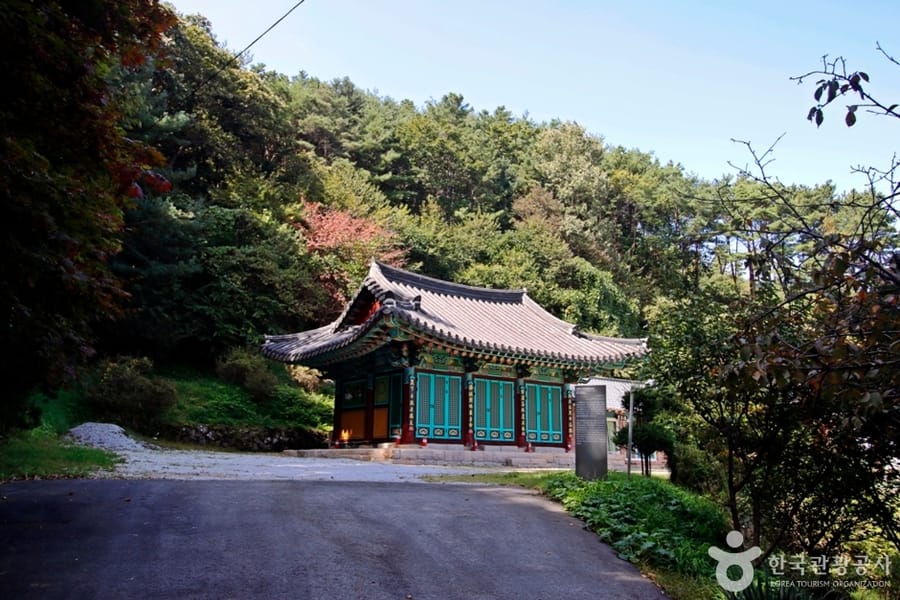
Gwan-eumsa Temple (Muju)
觀音寺- Era
- Founded 1938 · 근대
- Sect
- 조계종
92-38 Yangji-gil, Seolcheon-myeon, Muju-gun, Jeonbuk Special Self-Governing Province
Founded 1938 · 근대조계종
0 visitors
Verify your visit to unlock challenges.
Temple information
Muju Gwan-eumsa Temple is a nunnery of the Jogye Order, located at the foot of Baekun Mountain in Socheon Village, Seolcheon-myeon, Muju-gun. It began as a missionary center in 1938 and developed into a temple two years later, in 1940, by Master Seokssangdong. Centered around the Beopbojeon Hall, which was rebuilt in 1974 by Master Gwanjeong Seonghyorye, the Seon (Zen) room Mok-u-sil and the monks' quarters (yosa) are arranged next to it. The Wooden Avalokiteshvara Bodhisattva Statue of Gwan-eumsa Temple (Jeollabuk-do Tangible Cultural Heritage), enshrined in the main hall Beopbojeon, is a small Bodhisattva statue created in 1650 (the 1st year of King Hyojong's reign) by representative sculptor monks such as Muyeom, Seongsu, and Gyeongseong, who were active in the Jeolla region at the time. Although its face is somewhat large compared to its body, it effectively displays a stable posture, a prominent nose, and a neat cross-legged sitting position. The creation date of the Buddha statue is certain, and it clearly shows the typical characteristics of 17th-century wooden Buddha statues. Its material is wood, with a seated height of 61cm and a knee width of 38cm. It was designated as Jeollabuk-do Tangible Cultural Heritage in 2009. (Source: Digital Humanities Institute)