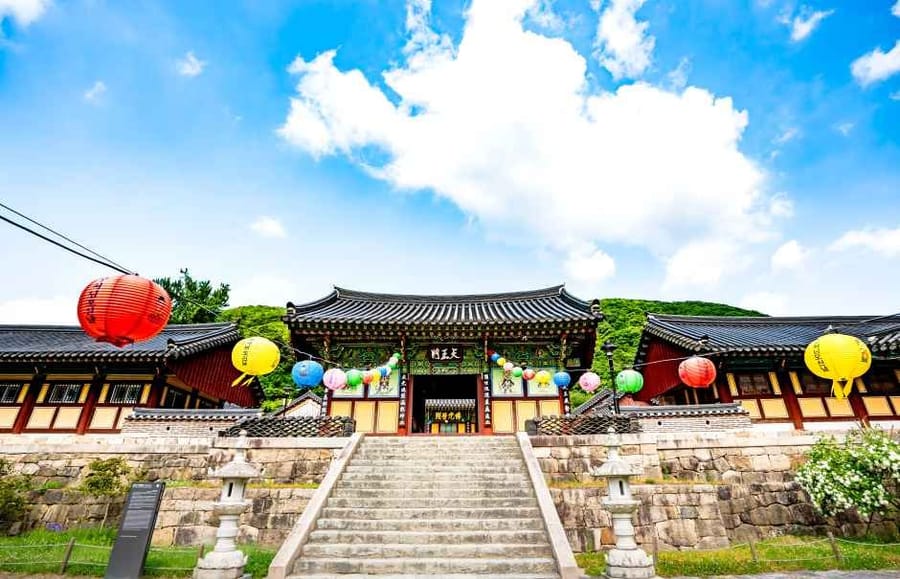
Bulgapsa Temple
佛甲寺- Era
- Founded 384 · 삼국시대
- Sect
- 조계종
- Feature
- Thousand-Year-Old Temple
450, Bulgapsa-ro, Bulgap-myeon, Yeonggwang County, Jeollanam-do
Founded 384 · 삼국시대조계종
0 visitors
Verify your visit to unlock challenges.
Temple information
Bulgapsa Temple, nestled at the foot of Bulgapsan Mountain in Yeonggwang County, is well-known as a famous spot where spider lilies bloom in full. As a subsidiary temple (mal-sa) of Baekyangsa Temple, the head temple of the 18th district of the Jogye Order of Korean Buddhism, it was named 'Bulgapsa (佛甲寺),' reflecting its significance as the first Buddhist doctrinal center established by Marananta when he introduced Buddhism during the reign of King Chimnyu of Baekje (384 AD). Here, structures such as Daeungjeon (the main Buddha hall) and Cheonwangmun (the Gate of Four Heavenly Kings), which preserve architectural styles from the mid-Joseon period onwards, are preserved. In the lush forest, one can find the yellow spider lily, an endangered wild plant. In autumn, red cluster amaryllis forms vast colonies, making it a beloved representative seasonal travel destination.