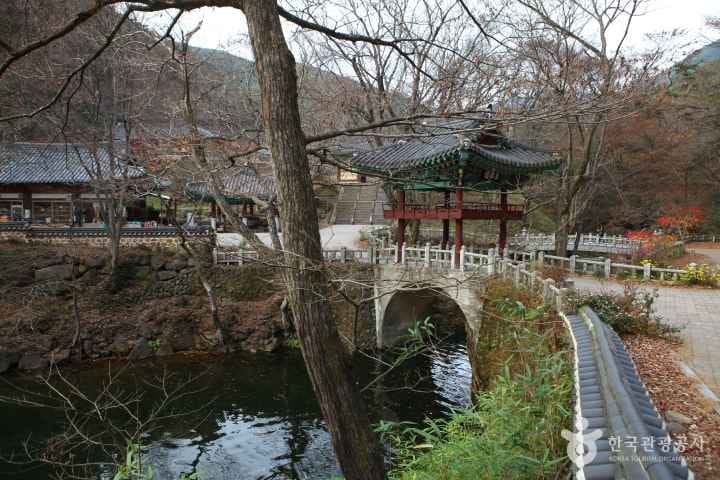
Cheoneunsa Temple (Gurye)
泉隱寺- Era
- Founded 828 · 통일신라
- Sect
- 조계종
- Feature
- Thousand-Year-Old Temple
209 Nogodan-ro, Gwangui-myeon, Gurye County, Jeollanam Province
Founded 828 · 통일신라조계종
0 visitors
Verify your visit to unlock challenges.
Temple information
Cheoneunsa Temple is located 9km north of Gurye-eup, at the entrance to the Jirisan Circumferential Road. It was founded in the 3rd year of King Heungdeok of Silla (828 AD) by Patriarch Deogun and the Indian monk ‘Seuru’. It was called Hwacheonyangsa and is considered one of the three major temples of Jirisan, along with Hwaeomsa Temple. It was destroyed by fire during the Imjin War, then rebuilt by Seonsa Hyejeong in the 2nd year of King Gwanghaegun of Joseon (1610). However, it burned down again in the 2nd year of King Sukjong (1676), and was rebuilt the following year. It suffered another fire in the 49th year of King Yeongjo (1773), and was rebuilt again by Seonsa Hyeam in the 51st year of King Yeongjo (1775), remaining to this day. The original name of Cheoneunsa was Gamnosa when it was founded in 828 by the Indian monk and Patriarch Deogun. This was because there was a spring in the temple grounds, clear and cold as dew, whose water was believed to clear a clouded mind. Many monks gathered there, with over a thousand residing at one point, and during the reign of King Chungnyeol of Goryeo, it was even elevated to the status of the foremost temple in the southern region. However, it is said that after it burned down during the Imjin War and was being rebuilt, a large python frequently appeared by the spring. When it was caught and killed, the spring stopped flowing. Therefore, because the spring "hid" (meaning the water disappeared), its name was changed to Cheoneunsa starting from the 4th year of King Sukjong of Joseon (1677). Strangely, after the name change, unexplained fires became frequent, and misfortunes never ceased. The local residents also feared, believing it was because the python, which protected the temple's water spirit, had been killed. Hearing this news, Wongyo Yi Gwang-sa, one of the four great calligraphers of Joseon, wrote "Jirisan Cheoneunsa" in a flowing style and hung it. It is said that no fires occurred thereafter. Even now, in the quiet hours of dawn, the subtle sound of flowing water is said to be heard from the calligraphy on the Iljumun (One Pillar Gate) signboard.