Beopjusa Temple
法住寺- Era
- Founded 553 · 삼국시대
- Sect
- 조계종
- Feature
- 33 Avalokiteśvara Sacred Sites, District Head Temple, UNESCO World Heritage, Thousand-Year-Old Temple
405 Beopjusa-ro, Songnisan-myeon, Boeun County, North Chungcheong Province
Founded 553 · 삼국시대조계종
0 visitors
Verify your visit to unlock challenges.
Temple information
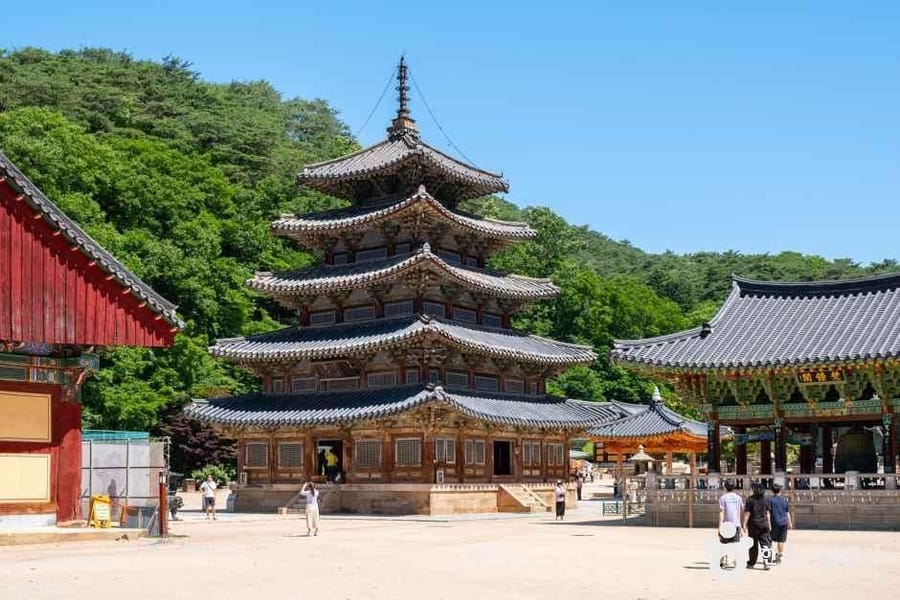
Beopjusa, meaning 'the temple where the Buddha's dharma resides', is located at the foot of Songnisan Mountain. It was founded by Uisinjo in the 14th year of King Jinheung of Silla (553 AD) and later rebuilt by King Seongdeok and King Hyegong, at which point it began to take on the scale of a grand temple. During the Goryeo period, King Gongmin, fleeing the Red Turban invasion, is said to have stopped by on his way back to the palace after taking refuge in Andong. King Taejo of Joseon also offered a hundred-day prayer before his enthronement, and King Sejo, who was ill, reportedly prayed for three days at Bokcheonam Hermitage. By the mid-Joseon period, it had become a magnificent temple boasting over 60 buildings and more than 70 hermitages. However, almost all its buildings were destroyed by fire during the Japanese invasions of Korea (Imjin War), and it was rebuilt again in 1624, the 2nd year of King Injo, by Ven. Byeogam. It has undergone several subsequent repairs to reach its present state. Previously, Beopjusa's temple layout featured a Hwaeom (Avatamsaka) faith axis centered on Daeungbojeon Hall and a Maitreya faith axis centered on Yonghwabojeon Hall, which intersected perpendicularly at Palsangjeon Hall. However, this arrangement was disrupted when the 33-meter-tall Bronze Maitreya Buddha was consecrated in 1990. Within the temple grounds, centered around Daeungbojeon Hall, there remain various halls such as Yonghwajeon, Wontongbojeon, Myeongbujeon, Neunginjeon, Josagak, Jinyeonggak, Samseonggak, along with over 10 monks' quarters including the temple office. More than half of Boeun's designated cultural heritage sites are concentrated in the Songnisan area, including Beopjusa, with Beopjusa alone boasting three National Treasures. Other notable features include Cheonwangmun (Gate of Four Heavenly Kings), Seonhuigung Wongdan where the spirit tablet of Royal Consort Yeongbin Yi, mother of Crown Prince Sado, was enshrined, Neunginjeon Hall housing the 16 Arhats, the Bodhisattva of Self-Sacrifice (Heegyeonbosalsang) who offered his body to the Buddha, and a stone cistern and iron cauldron large enough to hold 80 sacks of rice. Beopjusa, a place where Maitreya faith has been passed down through over a thousand years of history, offers temple stays where visitors can experience basic Buddhist culture, including prayers and ceremonial worship. Palsangjeon Hall, a five-story wooden pagoda, serves as important material for research on Korean wooden pagodas. It was built by Uisin during the Silla King Jinheung's reign, rebuilt by Byeongjin in 776, destroyed during the Jeongyujaeran (second Japanese invasion) in 1597, and then reconstructed in 1605, remaining to this day. It was named Palsangjeon (Hall of Eight Scenes) because its walls are adorned with 'Palsangdo' paintings depicting the Buddha's life in eight distinct scenes. Palsangjeon Hall became a crucial architectural structure, the only remaining example of a Korean wooden pagoda, after the three-story wooden pagoda used as Daeungjeon Hall at Ssangbongsa Temple was destroyed in 1984. Its total height, including the finial, is 22.7m, making it the tallest extant pagoda in Korea. Furthermore, Seokyeonji (Stone Lotus Pond) is considered a masterpiece created around the 8th century during the Unified Silla period. It features a magnificent stone lotus pond supported by three tiers of supports and a layer of inverted lotus pedestals placed on an octagonal base stone, with cloud-patterned decorative stones laid on top, creating an appearance as if a lotus flower is floating on clouds. The Twin Lion Stone Lantern is regarded as one of the outstanding works among Silla stone lanterns, estimated to have been created in the 19th year of King Seongdeok's reign (720 AD). This stone lantern, which replaces the central pillar with stone lions, deviates from typical styles. It features a lower lotus pedestal and a twin-lion lotus pedestal cushion, all carved from a single stone on an octagonal base. Its distinctive characteristics include a larger lamp chamber and roof stone compared to other stone lanterns.