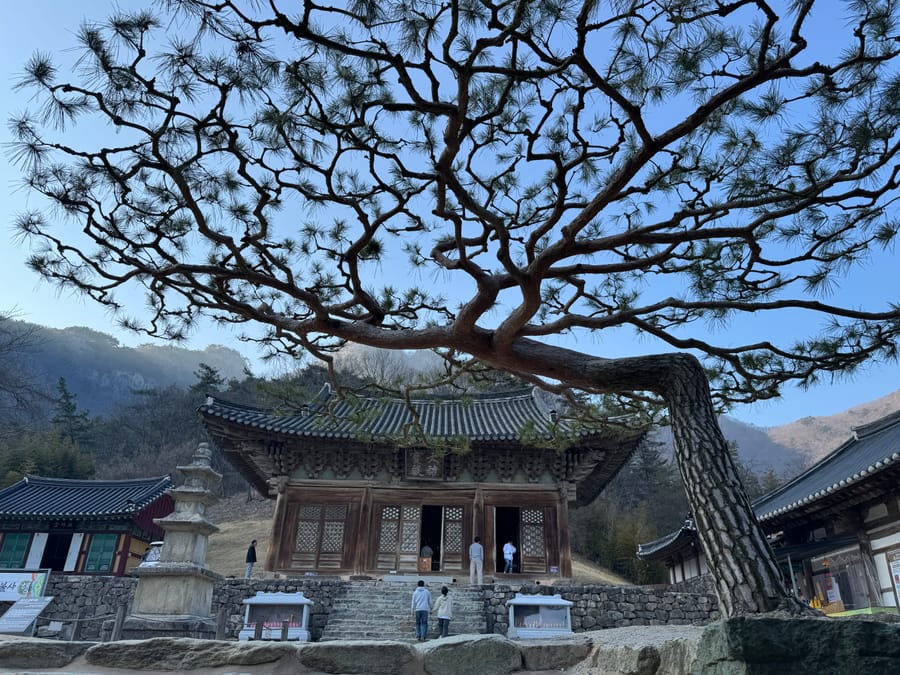
Seonunsa
禪雲寺- Era
- Founded 577 · 삼국시대
- Sect
- 대한불교조계종
- Feature
- 33 Avalokiteśvara Sacred Sites, District Head Temple, Thousand-Year-Old Temple
250 Seonunsa-ro, Asan-myeon, Gochang County, Jeonbuk Special Self-Governing Province
Founded 577 · 삼국시대대한불교조계종
0 visitors
Verify your visit to unlock challenges.
Temple information
Seonunsa Temple is the head temple of the 24th district of the Jogye Order of Korean Buddhism, located on Dosolsan Mountain in Asan-myeon, Gochang-gun, Jeonbuk Special Self-Governing Province. Dosolsan Mountain is also known as Seonunsan Mountain, and during the late Joseon Dynasty, when Seonunsa Temple was thriving, 89 hermitages and 189 monks' quarters were scattered across the mountain, forming a magnificent Buddhist pure land. Along with Geumsansa Temple in Gimje, it stands as one of the two great head temples of Jeonbuk Special Self-Governing Province, boasting a long history, outstanding natural scenery, and precious Buddhist cultural heritage, making it a destination that constantly draws pilgrims and tourists throughout all four seasons. Originally, the site of Seonunsa Temple was a large pond inhabited by a dragon. Around the time Ven. Geomdan expelled this dragon and began filling the pond with stones, a severe eye disease spread through the village. However, when a sack of charcoal was poured into the pond, the eye disease would miraculously heal as if washed away. As a result, villagers eagerly brought charcoal and stones, and the large pond was quickly filled. Afterwards, Seonunsa Temple was founded on that site. Ven. Geomdan is said to have named the temple 'Seonun (禪雲),' signifying 'to attain the state of Zen (禪) by cultivating oneself while dwelling in the cloud (雲), which represents the realm of profound wisdom.' Currently, it possesses various Buddhist cultural heritage items, including National Treasures, Natural Monuments, Jeonbuk Special Self-Governing Province Tangible Cultural Heritage, and Jeonbuk Special Self-Governing Province Cultural Heritage Materials. In particular, behind the Daeungjeon (Main Hall), a cluster of camellia trees, approximately 500 years old and averaging 6 meters in height, has been designated as a Natural Monument. In spring, when the flowers are in full bloom, it creates a spectacular sight, as if a floral screen unfolds behind the temple.