Gapsa Temple
甲寺- Era
- Founded 420 · 삼국시대
- Sect
- 조계종
- Feature
- Thousand-Year-Old Temple
567-3 Gapsa-ro, Gyeryong-myeon, Gongju City, Chungcheongnam Province
Founded 420 · 삼국시대조계종
0 visitors
Verify your visit to unlock challenges.
Temple information
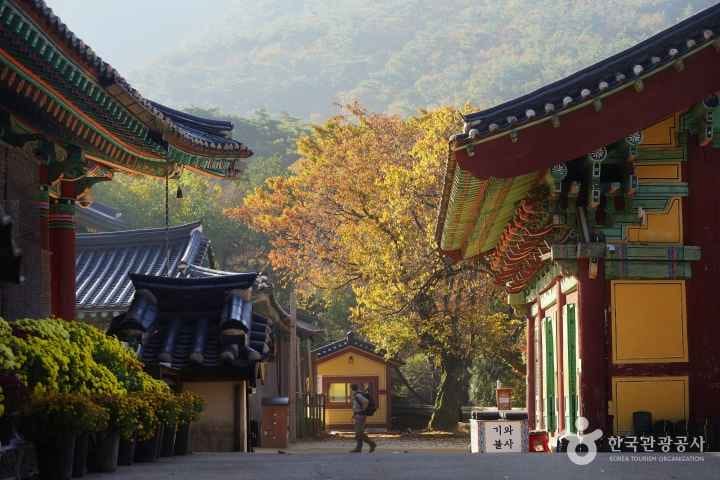
Gapsa Temple is located on the northwestern foothills of Gyeryongsan Mountain within Gyeryongsan National Park in Gongju City. It is a famous temple that was one of the ten great temples of the Hwaeomjong (Huayan school of Buddhism) during the Unified Silla period. It is densely covered with ancient pine and zelkova trees, and its beautiful autumn foliage is so renowned that an old saying, "Chunmagok Chu Gapsa" (Spring Magok, Autumn Gapsa), has been passed down through generations. The temple's origin dates back to its founding by Monk Ado, who came from Goguryeo in 420 AD, the first year of King Guisin of Baekje. Gapsa was called by various names such as Gyeryong Gapsa, Gapsa, Gapsasa, and Gyeryongsa. Among these, it is said that the name Gapsa (甲寺) comes from the character 'Gap' (甲), meaning 'first' or 'foremost,' indicating its status as the best among heaven, earth, and people. During the Joseon Dynasty, despite the suppression of Buddhism (Sungyuoegbul), Gapsa was an exception and even received royal patronage, going so far as to engrave the 'Worin Seokbo' (a Buddhist text). It was completely burned down during the Jeongyujaeran (Second Japanese Invasion of Korea) in 1597, but reconstruction began in 1604 (37th year of King Seonjo) with the rebuilding of the Daeungjeon (Main Buddha Hall) and Jinhaedang, and it has continued to the present day. Thanks to this history, various valuable cultural heritage items are still preserved within the temple. Around the temple, there are numerous scenic spots such as Yongmun Falls, Sujeongbong Peak, Cheonjinbotap Pagoda, and Gunjadae Terrace. In particular, the southern valley is famous for its "Nine Bends," forming a breathtaking landscape. The general public can participate in Buddhist services and temple stays held at the temple.