Hwaeomsa Temple

Hwaeomsa Temple華嚴寺

교구본사33관음성지천년고찰

539 Hwaeomsa-ro, Masan-myeon, Gurye County, South Jeolla Province

Founded 544 · 삼국시대

조계종

지리산, 각황전(국보), 사사자삼층석탑(국보)

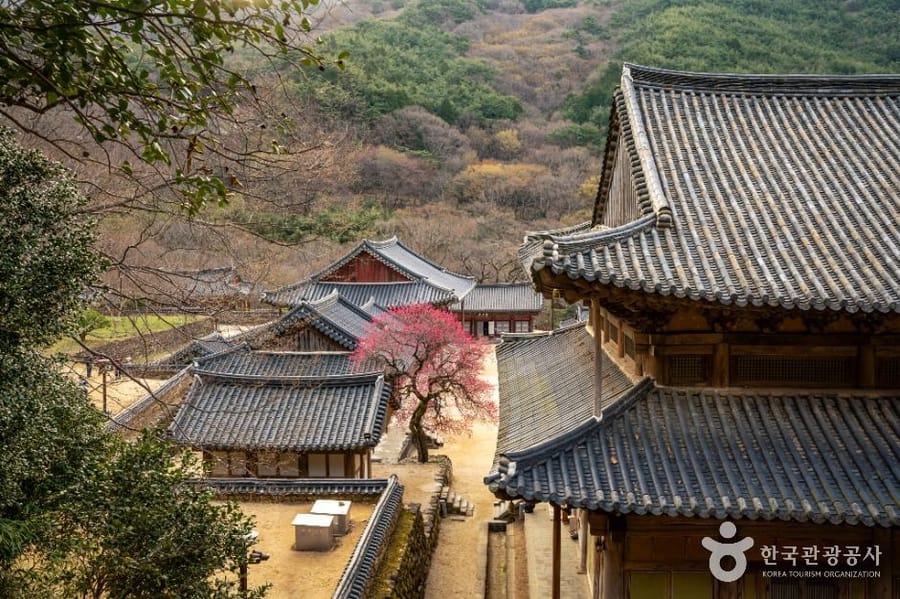
Hwaeomsa Temple, a thousand-year-old ancient temple, is located 5.4 km east of Gurye-eup, at the foot of Jirisan Mountain, the spiritual mountain of the nation. It is said that the temple was founded in 544 (the 22nd year of King Seong of Baekje) by Buddhist monk Yeongi-josa, and its name was derived from the two characters "Hwaeom" of the Avatamsaka Sutra (Hwaeomgyeong). Initially, only the Haehoedang and Daeungsangjeokgwangjeon halls were built. Afterwards, it was expanded in 643 (the 12th year of Queen Seondeok) by Monk Jajangyulsa, and again in 875 (the 1st year of King Heongang of Silla) by National Preceptor Doseon. After being destroyed by fire during the Imjin War, reconstruction was started in 1630 (the 8th year of King Injo) by Zen Master Byeogam, and completed seven years later in 1636 (the 14th year of King Injo). Within the temple grounds, there are many cultural heritage items, including four National Treasures, five Treasures, one Natural Monument, and two local cultural heritage items, as well as about 20 subsidiary buildings, including the Gakhwangjeon Hall. Particularly unique in the arrangement of buildings is that after passing through Iljumun Gate and turning about 30 degrees to the northeast, one reaches Cheonwangmun Gate, which enshrines statues of Geumgangyeoksa (Diamond Vajra), Manjusri, and Samantabhadra. This gate is offset from Geumgangmun Gate in a westerly direction. Going further past this Cheonwangmun Gate, one reaches Bojeru Pavilion. Unlike other temples where one passes underneath the pavilion to reach Daeungjeon Hall, here one walks around the side of Bojeru. From there, two pagodas, east and west, are visible in a diagonal direction. Daeungjeon Hall is located on a terrace one level higher than the upper part of the east pagoda, and Gakhwangjeon Hall is located on the upper part of the west pagoda. Among the buildings in the temple grounds, Gakhwangjeon Hall is a very famous building designated as a National Treasure. It is the largest existing wooden structure in Korea, and its magnificent exterior overwhelms the viewer's gaze. The stone lantern standing in the courtyard in front of Gakhwangjeon Hall is 6.3m high and 2.8m in diameter, the largest in Korea, and is designated as National Treasure No. 12. It is a work that showcases the brilliant sculptural art of the Buddhist renaissance period of the Unified Silla Dynasty. The Four-Lion Three-story Stone Pagoda, located on a hill called Hyodae to the left of Gakhwangjeon Hall, is a National Treasure. It is a masterpiece that boasts a unique design and sophisticated carving skills, built by the founder of Hwaeomsa, Monk Yeongi-josa, to pray for the repose of his mother's soul. The Yeongsanhwoe Gwaebultaeng (Large Hanging Painting of the Vulture Peak Assembly), located at the back of the interior of Gakhwangjeon Hall, was designated as a National Treasure in 1997. Among the treasures within Hwaeomsa Temple grounds, the five-story pagodas standing on either side of Daeungjeon Hall are designated as Treasures. They are works from the Silla Dynasty that attract attention with their excellent formative quality and delicate decorations. In addition, Daeungjeon Hall (a Treasure) here showcases the excellent artistry of the Joseon Dynasty, and many scenic spots and beautiful landscapes are scattered throughout, set against the magnificent backdrop of Jirisan National Park. Meanwhile, along National Road No. 19 from Hadong to Hwaeomsa Temple (about 35 km), cherry trees are planted as roadside trees. Every April, when the cherry blossoms are in full bloom, it becomes a fantastic drive course. Nearby, there are many tourist attractions such as Seomjingang Maehwa Village, Gososeong County Park, Jirisan National Park, and Ssanggyesa Temple, making it a place where countless spring visitors flock.

10km