151-1 Umae-ri, Hwanggan-myeon, Yeongdong-gun, Chungcheongbuk-do
Founded 720 · 삼국시대
조계종
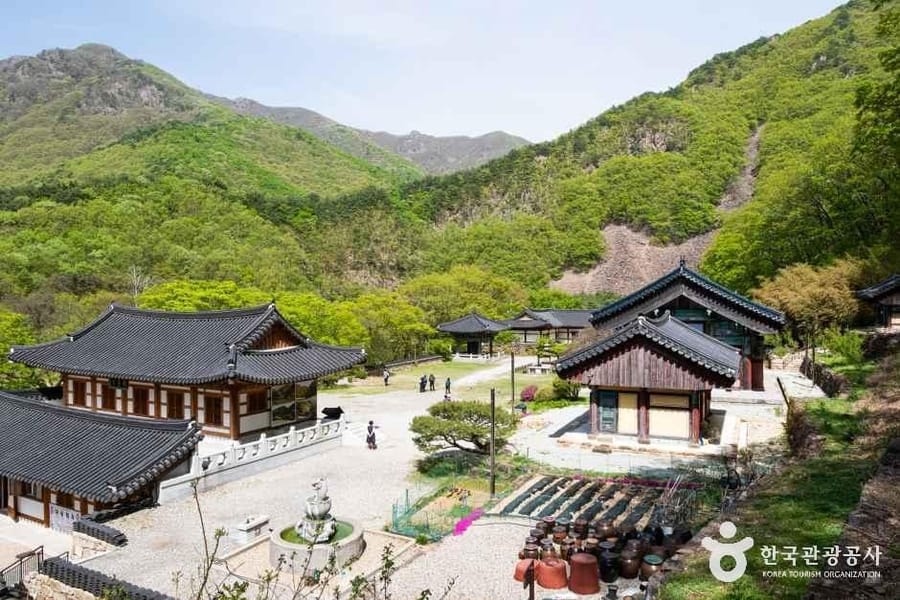
A large stream flowing down from Baekhwasan Mountain winds around the mountainside in a Taegeuk pattern, forming a lotus-shaped terrain, with Banyasa Temple located at the center of the lotus. It is also known as a temple that embraces a tiger, and it is a thousand-year-old temple founded in the 27th year of King Seongdeok of Silla (728 AD) by Sangwon Hwasang, one of Wonhyo Daesa's ten great disciples. It was later rebuilt in the 12th year of King Chungsuk of Goryeo (1325 AD) by Hakjo Daesa, and then greatly expanded in 1464 (the 10th year of King Sejo) with King Sejo's permission. It is uncertain when Geungnakjeon Hall was rebuilt, but it has recently been repaired and dancheong (traditional Korean decorative painting) applied, making its condition neat and charming. To the northeast, Baekhwasan Mountain soars, and in the Seokcheon Valley flowing in front of the temple, there is a large stream about 50m wide with flat rock slabs, forming the scenic beauty of Manggyeongdae Pavilion amidst green water and clear mountains. This is where King Sejo visited Banyasa Temple after a Dharma assembly at Bokcheonam Hermitage of Beopjusa Temple on Songnisan Mountain. As King Sejo was strolling through the temple grounds, it is said that Manjusri Bodhisattva (Munsu Dongja) appeared from somewhere and guided King Sejo to a nearby excellent medicinal spring, advising him to bathe. After resting at Manggyeongdae Pavilion under the guidance of Manjusri Bodhisattva, King Sejo considered his encounter with Manjusri Bodhisattva significant and left a written record, which is said to be still preserved today. The temple was named Banyasa because of the belief that Manjusri Bodhisattva resides around this temple, and its name symbolizes the prajna (wisdom) of Manjusri. At Yeongdong Banyasa Temple, along with the Banyasa Tiger on the slopes of Baekhwasan Mountain, a crape myrtle tree over 500 years old is famous, and within the temple grounds is the Three-story Stone Pagoda of Banyasa Temple, designated as a treasure. The Banyasa Tiger, resembling a tiger with its tail raised, is formed by fragmented rocks piled on the mountainside behind the temple, measuring 80m high and 200m long. It is said to have been naturally created by thousands of years of rockfalls from the slopes of Baekhwasan Mountain, intertwined with the surrounding trees. Meanwhile, the Three-story Stone Pagoda of Yeongdong Banyasa Temple, designated as a treasure, was originally located at Tapbeol in Seokcheon Valley north of Banyasa Temple and was moved to its current location in 1950. Judging from its overall style, it is presumed to have been built in the early Goryeo Dynasty and is characterized by a blend of Baekje and Silla stone pagoda styles. Currently, Banyasa Temple operates various temple stays. It offers experiential temple stays for those who are tired, seeking comfort, and restorative Prajna (wisdom) temple stays to help individuals find the wisdom to comfort themselves.