5-2 Su-dong, Sangdang District, Cheongju City, North Chungcheong Province
Founded 720 · 삼국시대
태고종
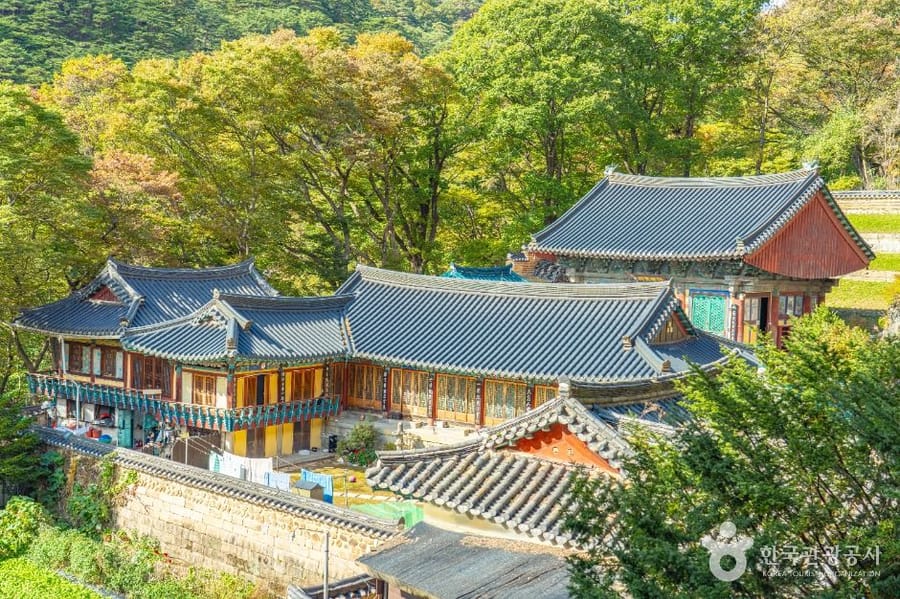
Bokcheonam Hermitage, located in Sanae-ri, Naesokri-myeon, Boeun-gun, Chungcheongbuk-do, within Songnisan National Park, was founded in 720 (the 19th year of King Seongdeok of Silla) and underwent multiple renovations from the Goryeo Dynasty to the Joseon Dynasty. According to the Sinjeung Dongguk Yeoji Seungnam (Augmented Survey of the Geography of Korea), there is a spring to the east of Bokcheon Temple where water gushes out from between the rocks, providing ample water for Buddhist rituals, hence it was called Bokcheon, and the temple's name originated from this. It is said that King Sejo of Joseon, after praying at this temple for three days in 1464, bathed in a bathhouse on the path leading to the temple. When his skin disease was completely cured, he ordered the renovation of the temple and bestowed a square jade tablet inscribed with 'Mannyeon Bolyeok' (eternal protection/power). The hermitage was burned down in 1592 but was soon rebuilt. After it was later destroyed, it was re-established in 1735 (11th year of King Yeongjo) and renovated in 1803 (3rd year of King Sunjo). Existing buildings include Geungnakjeon (Hall of Ultimate Bliss), Nahan Hall, Seonbang (meditation hall), and Yosachae (monks' living quarters). Bokcheonam Geungnakjeon was dismantled and restored in 1976. Inside, it preserves an Amitabha Buddha statue, a Buddhist painting behind the main altar, paintings of the Buddhas of the Three Ages, paintings of guardian deities, Geungnakbojeon, the stupa of Monk Suam, the stupa of Monk Hakjo, and a Buddhist painting by Great Monk Shinmi. The signboard 'Muryangsu' (Infinite Life/Light) is said to be King Gongmin's autograph. Among the relics, two stupas are handed down. The Bokcheonam Suam Hwasang Stupa, made in 1480 (11th year of King Seongjong), enshrines the sarira (relics) of Monk Suam, a Joseon Dynasty monk. The Bokcheonam Hakjo Deung-gok Hwasang Stupa, located behind this stupa, was made in 1514 (9th year of King Jungjong) and enshrines the sarira of Great Monk Hakjo. They exhibit a much more developed form than typical bell-shaped stone stupas. Both stupas were designated as Chungcheongbuk-do Tangible Cultural Heritage and were promoted to Treasure in 2004. Songnisan is deep and vast, with many hermitages established there. Bokcheonam has the longest history and is also the largest temple in terms of scale. Because it is a temple in the form of a hermitage, it operates more as a Zen monastery than as a temple for general lay devotees. Following the hiking trails, one can reach Munjangdae, Birobong, and Cheonwangbong peaks, where one can enjoy the spectacular scenery of Songnisan, and also discover hidden hermitages in the mountains such as Sanggoam and Sanghwanam.