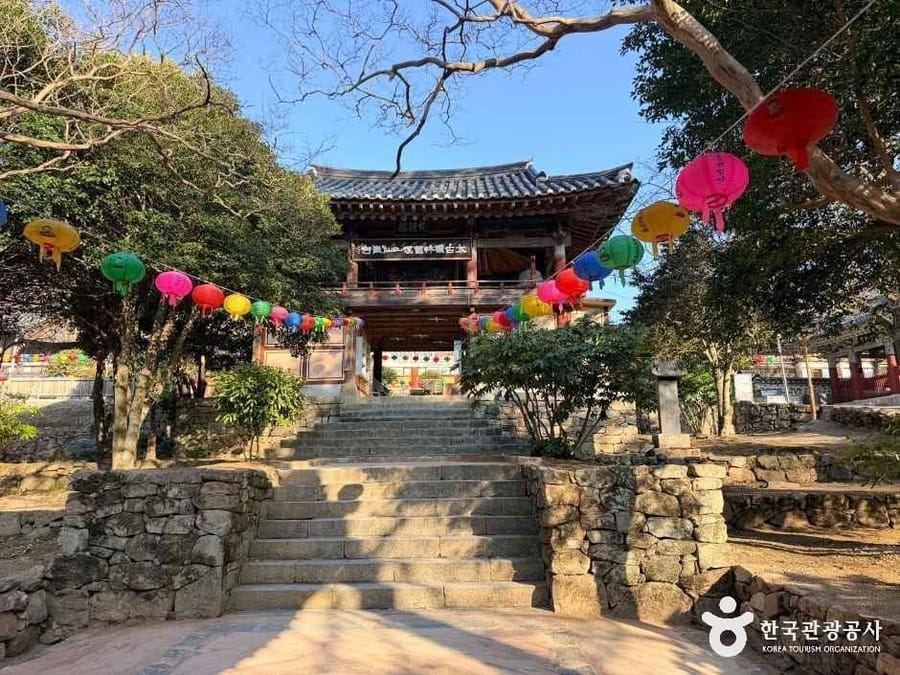
Seonamsa Temple
仙巖寺- Era
- Founded 529 · 삼국시대
- Sect
- 태고종
- Feature
- UNESCO World Heritage, Thousand-Year-Old Temple
450 Seonamsagil, Seungju-eup, Suncheon City, South Jeolla Province
Founded 529 · 삼국시대태고종
0 visitors
Verify your visit to unlock challenges.
Temple information
Seonamsa Temple, situated on the eastern foothills of Jogyesan Mountain, was founded in 529 CE (7th year of King Seong of Baekje) when Monk Ado built Biroam Hermitage. Later, in the 1st year of King Gyeongmun of Silla, State Preceptor Doseon established the current Seonamsa Temple, following the Dongni-sanmun style of Seon Buddhism, one of the nine mountain Seon schools. On the opposite side, on the western slope of the mountain, lies the famous Songgwangsa Temple, a Seungbo (monastic Jewel) temple. Around Seonamsa Temple, centuries-old oak, camellia, maple, and chestnut trees grow in lush profusion, and the autumn foliage is particularly renowned. Furthermore, in front of the temple stands Seungseongyo Bridge (a Treasure), an arched bridge built on natural rock foundations, making it sturdy, and its central dragon head is very mystical. The three-story stone pagodas (Treasures) standing on both sides in front of the Daeungjeon (Main Hall) also attract the attention of tourists. As one of the temples where traditional temple culture remains most intact, besides seven national treasures, there are twelve local cultural assets including the majestic and splendid Daeungjeon, Palsangjeon, Wonjongjeon, a gilt-bronze incense burner, and Iljumun Gate. Following the hiking trail to the left of the main Seonamsa complex, one can see a Buddhist carving (Ma-aebul) etched into a massive rock measuring 7m high and 2m wide. The 800-year-old wild tea plantation, the Jogyesan hiking trail connecting Songgwangsa and Seonamsa, crystal-clear valley streams, lush trees, and autumn leaves all add to the beauty of this place. Moreover, like Jirisan and Baekunsan Mountains, maple trees (gorosoe-namu) grow wild in the vicinity of Seonamsa, allowing visitors to taste their medicinal sap around the time of Gyeongchip (Awakening of Insects) each year. Seonamsa Chiljeon Seonwon is a place for Seon meditation located within Seonamsa Temple, situated on the eastern foothills of Jogyesan Mountain in Songju-eup, Suncheon City. As Taego Chonglim, the only comprehensive monastic training center (Chonglim) of the Taego Order, it is a comprehensive training ground where numerous monks practice in its Gangwon (lecturing institute) and Seonwon (meditation hall). 'Chiljeon' refers to a cluster of seven buildings located at the highest point of Seonamsa Temple. Behind Seonamsa Temple, there is a wild tea field with a colony of self-grown tea plants over 800 years old. While wild tea produced in general tea-growing regions considers Hwagae tea to be of the highest quality, truly wild-grown tea (pure natural wild tea) considers Seonamsa tea to be the best. The characteristic of Seonamsa wild tea is described as "savory and deeply flavored," which comes from the tea plants growing in the shade of lush cedar and oak trees, resulting in tender tea leaves, and the misty, humid climate creating a rich flavor. However, tasting Seonamsa tea is not easy. The Seonamsa tea fields are not large, so the harvest is small, and the tea is highly prized.