Geonbongsa Temple
乾鳳寺- Era
- Founded 520 · 삼국시대
- Sect
- 조계종
- Feature
- Thousand-Year-Old Temple
723 Geonbongsa-ro, Geojin-eup, Goseong County, Gangwon Special Self-Governing Province
Founded 520 · 삼국시대조계종
0 visitors
Verify your visit to unlock challenges.
Temple information
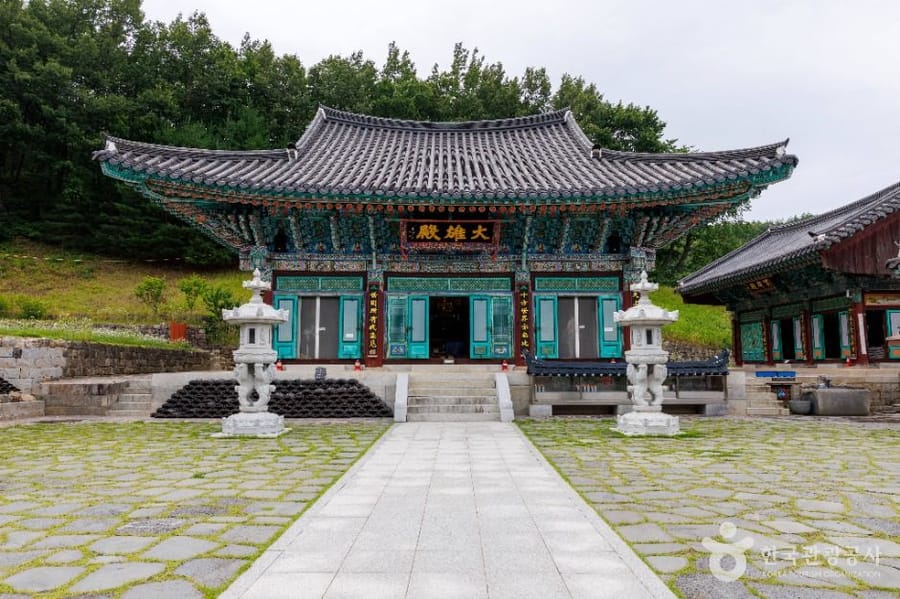
Geonbongsa Temple on Geumgangsan Mountain is an old temple located on the southeastern foothills of Gamnobong Peak, where the Geumgangsan mountain range begins, and it enshrines the true tooth relics of Sakyamuni Buddha. Although it was once a large temple spanning 3,183 'kan', all but the Bulimun (Gate of Non-Duality) disappeared during the Korean War. Restoration work began in 1994 and has led to its current appearance. It is also a Hoguksa Temple (a temple protecting the nation), where monks organized warrior-monk armies during the Japanese invasions of Korea (Imjin War) and which established itself as a center for anti-Japanese independence movements during the Japanese colonial period. It is said that in the 7th year of King Beopheung of Silla (520 AD), the monk Ado first built a temple here under the name Wongaksa. In the 17th year of King Gyeongdeok of Silla (758 AD), the monk Baljing rebuilt the temple and established the "Manilhoe," a gathering for chanting Buddhist scriptures for 10,000 days as a practice, and this gathering became the origin of Korea's "Yeombul Manilhoe" (a Buddhist ritual of chanting for 10,000 days to pray for rebirth in the Pure Land of Sukhavati). Later, in the 7th year of King Gongmin of Goryeo (1358 AD), Master Naong changed its name to its current one. In the 2nd year of King Sejo of Joseon (1456 AD), the king visited and designated this place as a royal 'Wondang' (a temple or shrine within a temple where ancestral tablets or portraits are enshrined to pray for the well-being or repose of individuals, here for the royal family's peace and prosperity), and built the Eosilgak shrine to enshrine the ancestral tablets of successive kings, thus making it a large temple. In the 15th year of King Gojong of Joseon (1878 AD), it burned down completely due to a fire and was rebuilt the following year. In the 10th year of Gwangmu, Korean Empire (1906 AD), Bongmyeong School was established for enlightenment thought and new cultural education, becoming a center of education in the Gwandong region, but it was forcibly closed by the Japanese colonial government. In 1911, it recovered its scale, overseeing 9 branch temples and becoming one of the 31 head temples. During the Korean War, as fierce battles of offense and defense continued for about two years in the Goseong region, all buildings except the Bulimun (Gate of Non-Duality), which was built in 1920, collapsed and it became a complete ruin. The site of Geonbongsa Temple, after the armistice, fell north of the Civilian Control Line, but civilian access became possible starting in 1989.