Around Sublime Stillness Temple

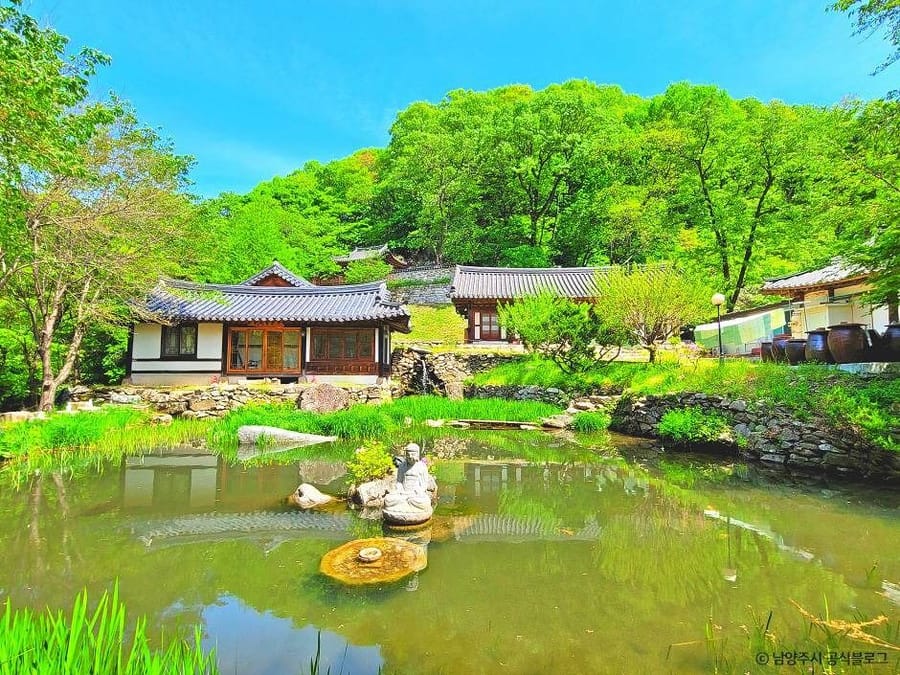
Sublime Stillness Temple
Myojeoksa Temple is a subordinate temple of Bongseonsa, which is the 25th head temple of the Jogye Order of Korean Buddhism. It is said to have been founded by Great Master Wonhyo during the reign of King Munmu of Silla, but there are currently no records or artifacts remaining to substantiate this claim. Historical documents such as "Sejong Sillok," "Yeonsangun Ilgi," and "Sinjeung Dongguk Yeoji Seungnam" mention Myojeoksa, indirectly indicating that its status was maintained in the early Joseon Dynasty. The octagonal seven-story stone pagoda in front of the Daeungjeon (Main Buddha Hall) is also presumed to be from that era. After its founding, Myojeoksa was left in ruins until the early Joseon period. During the reign of King Sejong, Monk Hakyeol rebuilt approximately 180 bays (kan), and it is recorded that northern and southern military camps were established and used as a site for military examinations. Meanwhile, according to a legend passed down through the temple, Myojeoksa was originally a secret institution directly under the king. It is said that a temple was built here to train royal secret agents, who were ordained as monks to receive both monastic education and advanced military training. Due to this alleged role, it reportedly faced concentrated attacks from Japanese forces during the Imjin War, successfully repelling two attacks but ultimately being completely destroyed in the final assault. About 20 meters east of the Daeungjeon, there is the tomb and stele of a person named Lee Jemyon. The stele, dated 1720 (the 46th year of King Sukjong), suggests that the temple was largely in ruins around that time. The period when Myojeoksa was rebuilt again is the 19th century. According to "Myojeoksan Sansingak Changgeon-gi," a record remaining in the temple, Monk Gyu-oh rebuilt the Sansingak (Mountain Spirit Shrine) in 1895 (the 32nd year of King Gojong). Later, in 1969, the Daeungjeon, Sansingak, and other structures were destroyed by fire. In 1971, the Daeungjeon and the monks' living quarters (Yosa) were rebuilt by Monk Jasin. Subsequently, in 1976, the Daeungjeon, Gwaneumjeon (Avalokitesvara Hall), and Mahaseonsil (Meditation Hall) were rebuilt. The Nahajeon (Arhat Hall) was built in 1979, and the Sanryeonggak (Mountain Spirit Pavilion) in 1984.