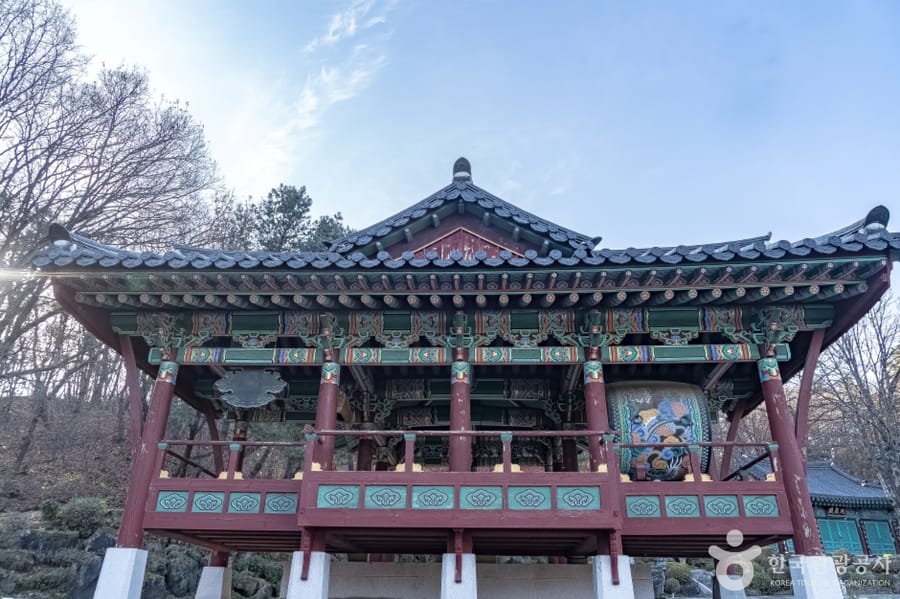
Daebopsa Temple

Daebopsa Temple大法寺

3-43 Angeum 3-gil, Ganam-eup, Yeoju-si, Gyeonggi-do

Founded 1971 · 현대

조계종

Daebeopsa Temple is located at the foot of Daeposan Mountain, and a story about Empress Myeongseong’s birth is associated with it. It is a branch temple of Yongjusa Temple, the head temple of the 2nd district of the Jogye Order of Korean Buddhism, and is registered as a traditional temple in Gyeonggi Province. Flowering trees and lotus ponds planted throughout the serene temple grounds offer beautiful scenery. Daebeopsa was founded in 1971, so its history is not very old. However, it is said that a temple had existed on this site since the reign of Queen Jinseong of Unified Silla during the North-South States period, although the exact founding date is unknown. At its original founding, a 0.9-meter standing Maitreya Buddha statue was enshrined, and it was called Mireukdang (Maitreya Hall). During the Joseon Dynasty, it became famous due to its connection with Empress Myeongseong and her father, Min Chi-rok. This began during King Sukjong's reign when the tomb of Min Jin-hu, Queen Inhyeon's elder brother, was built near the temple. Min Chi-rok, Empress Myeongseong's father, who was managing this tomb, dreamt of the Maitreya Buddha. He dug up the ground, found the Maitreya Buddha statue, and then built a new dharma hall to enshrine the Buddha. His wife, Lady Han San Yi, prayed diligently and gave birth to Empress Myeongseong. Afterwards, when Empress Myeongseong was enthroned as King Gojong's consort, a Daeungjeon (Main Buddha Hall) was built where the Maitreya Buddha statue was, and the temple was renamed Wongdangsa, prospering with the support of the Min family. However, with the passage of time, Wongdangsa disappeared, becoming almost derelict with only traces remaining, until it was reborn as today's Daebeopsa. The monk Dae-won, who re-founded the temple, also named it Daebeopsa after seeing the name "Daebeopsa" in a book he dreamt about. The temple grounds include Iljumun (One Pillar Gate), Daeungjeon (Main Buddha Hall), Jijangjeon (Ksitigarbha Hall), Beomjonggak (Bell Pavilion), Guksadang (National Shrine), and Samseonggak (Three Sages Hall). The Daeungjeon, built in 1971 and renovated in 1989, is a building with 5 kan (bays) in the front and 3 kan on the sides, featuring a multi-bracketed hip-and-gable roof (dapogye paljakjibung), and enshrining Sakyamuni Buddha, Avalokiteshvara Bodhisattva, and Mahasthamaprapta Bodhisattva. In front of the Daeungjeon are a stone lantern, a three-story stone pagoda, and a seated Medicine Buddha, while climbing the hill behind leads to a 9-meter-tall Maitreya stone Buddha and a seven-story stone pagoda. In a small stone chamber next to the Daeungjeon, the Maitreya Buddha statue connected to Empress Myeongseong is enshrined; its worn appearance suggests how many wishes it has listened to over a long period. In the Guksadang at the temple entrance, two Buddhist paintings (tankhwa) are hung. The left one depicts San-sin (Mountain Spirit). The right one, instead of the usual tiger, shows a scholar on horseback, said to be Min Chi-rok.