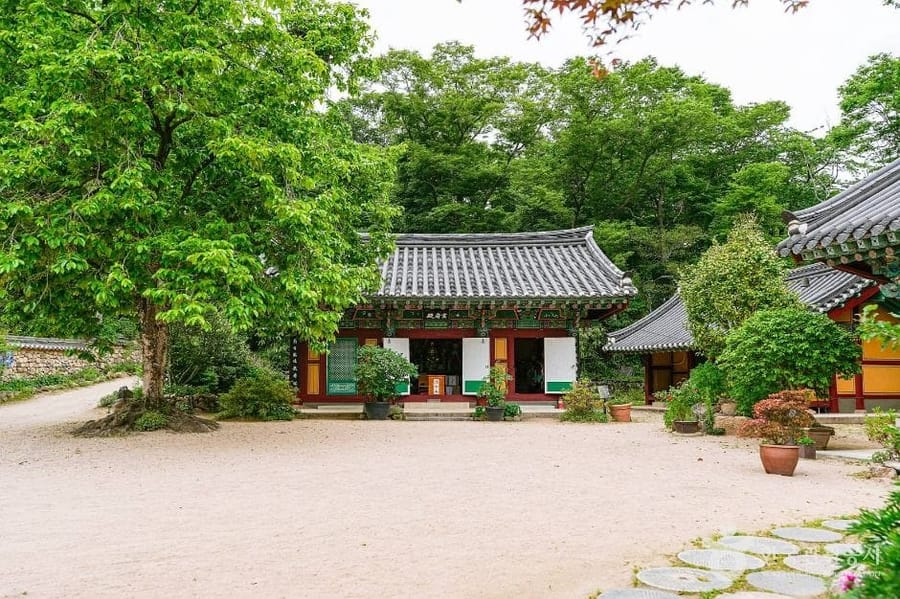
Girimsa Temple
祇林寺- Era
- Founded 643 · 삼국시대
- Sect
- 조계종
- Feature
- 33 Avalokiteśvara Sacred Sites, Thousand-Year-Old Temple
Girim-ro 437-17, Yangbuk-myeon, Gyeongju City, Gyeongsangbuk Province
Founded 643 · 삼국시대조계종
0 visitors
Verify your visit to unlock challenges.
Temple information
Girimsa is a temple founded during the reign of Queen Seondeok of Silla. It was initially called Imjeongsa but was renamed Girimsa when Wonhyo expanded its grounds. Girimsa is largely divided into two areas: one area contains Daejeokgwangjeon, which enshrines the Vairocana Buddha, and a large Bodhi tree over 500 years old, and the other area contains the Museum, Samseonggak, Myeongbujeon, Gwaneumjeon, and so on. Daejeokgwangjeon, the main hall of Girimsa, is a single-story, gable-roofed building featuring dapoga-style architecture with entasis columns, and it enshrines a triad of Buddhas that represent the typical style of early Joseon Buddhist statues. To the west, between Daejeokgwangjeon and Jinnamru, is Obeongnahanjeon, and directly in front of it is a three-story stone pagoda. The Seongbo Museum houses many cultural heritage materials, including a dry-lacquer Bodhisattva with one leg crossed over the other, designated as a treasure, as well as Buddhist texts from inside the Vairocana Buddha statue, wooden tablets, stone figures, earthenware figurines, and more. Girimsa is famous for its "Ojongsu," or Five-Flavored Waters, which are said to have five distinct tastes. These include Gamrosu, said to be the best-tasting when brewed into tea; Hwajeongsu, said to bring peace of mind even when drunk plain; Janggansu, said to strengthen one's constitution; Myeongansu, said to clarify one's vision; and Otaksu, whose water color was so beautiful that crows pecked at it. However, during the Japanese colonial period, fearing the birth of a great general, the water source of Janggansu was blocked, and now only four springs are flowing. Girimsa also operates mountain temple experience programs and templestays, offering both self-guided programs for relaxation and experiential programs with monks, which include participating in Buddhist services and performing 108 prostrations. Structured with seasonal themes, these programs offer green tea making in spring, a meditation path experience at Yongyeon Waterfall in summer, aged tea tasting and mountain temple concert viewing in autumn, and bell-ringing ceremonies and sunrise viewing over the East Sea in winter. In addition, visitors can also experience mandala drawing, the Mahasa summer retreat, and the children's summer Buddhist school.