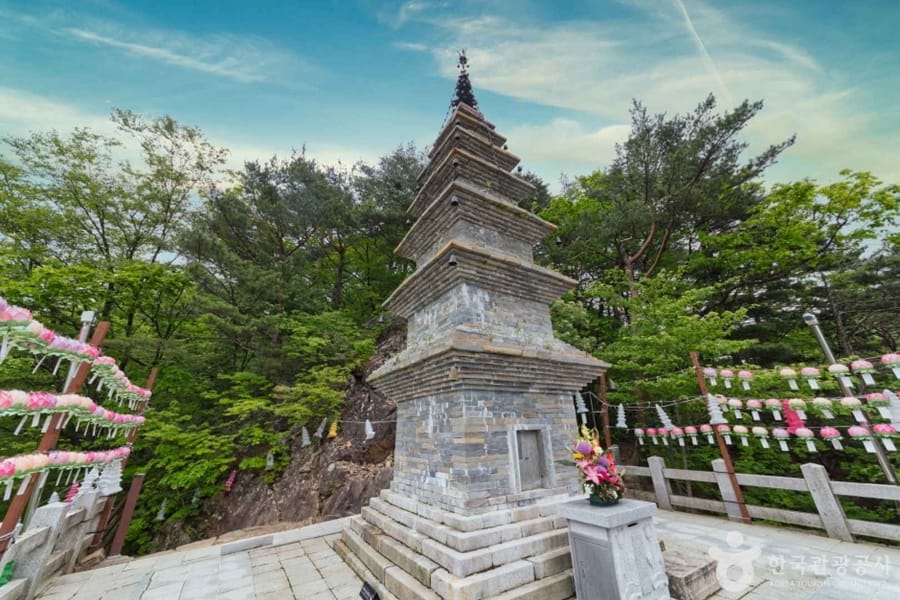
Jeongamsa Temple
淨巖寺- Era
- Founded 643 · 삼국시대
- Sect
- 조계종
- Feature
- 5 Great Buddha-Relic Shrines, Thousand-Year-Old Temple
Hambaeksan-ro 1410, Gohan-eup, Jeongseon County, Gangwon Special Self-Governing Province
Founded 643 · 삼국시대조계종
0 visitors
Verify your visit to unlock challenges.
Temple information
According to legend, the Sumanotap Pagoda of Jeongamsa Temple originates from the story that the Silla monk Jangjayulsa, on his way back from Tang China, received agate stones from the Dragon King of the West Sea and used them to build the pagoda. The name 'Sumano' means blue agate stones retrieved from the water. The rock material forming the pagoda is actually dolomite (a calcium and magnesium carbonate mineral), not agate. It appears that the blue stone was symbolically recognized as agate during the transmission of the legend. This can be seen as a unique example of cultural heritage where historical reality and mythical imagination are intertwined. This seven-story imitation-brick stone pagoda, reaching approximately 9m in height and 3.04m in width, is very rare because its finial and wind chimes are preserved close to their original forms, and its artistic value is also highly appreciated. Due to the lower durability of imitation-brick stone pagodas compared to regular stone pagodas, it has undergone several repairs, and the current Sumanotap Pagoda was rebuilt during the Goryeo Dynasty. During the dismantling and repair process in 1972, sarira reliquaries containing the Buddha's relics and ancient documents were discovered, re-illuminating its historical and religious significance. Recognizing these historical, artistic, and religious values, it was elevated to a National Treasure in 2020.