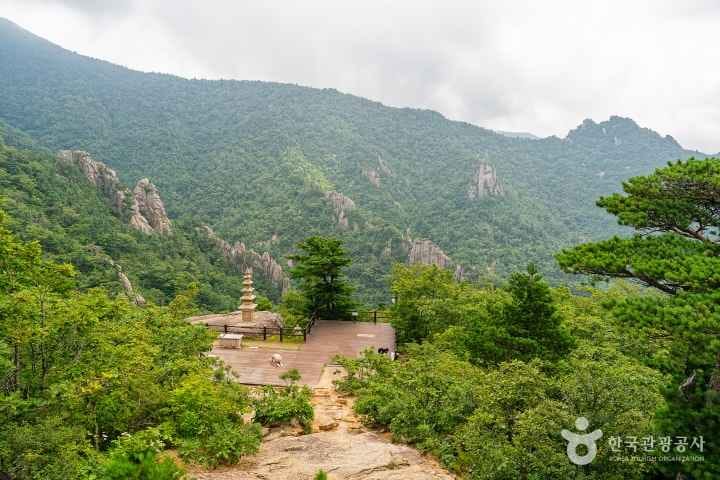
Bongjeongam
鳳頂庵- Era
- Founded 643 · 삼국시대
- Sect
- 조계종
- Feature
- 5 Great Buddha-Relic Shrines, Thousand-Year-Old Temple
Baekdam-ro 1700, Buk-myeon, Inje County, Gangwon Special Self-Governing Province
Founded 643 · 삼국시대조계종
0 visitors
Verify your visit to unlock challenges.
Temple information
Bongjeongam is a temple located within Seoraksan National Park, an annex hermitage of Baekdamsa Temple in Nae-Seorak, situated at Madeungnyeong, the highest point in Seoraksan. It is one of the five Great Jeokmyeolbogung, enshrining Sakyamuni Buddha's true sarira, and is a sacred site visited by many Buddhist devotees. It was founded in the 13th year of Queen Seondeok's reign by Jajang Yulsa, a revered monk of Silla. It has reached its present state through multiple reconstructions, including those by Great Monk Wonhyo during the Unified Silla period and Jinul during the Goryeo dynasty. The name Bongjeongam is derived from the legend that a phoenix disappeared into Buddha's forehead. Located at an altitude of 1,244m above sea level, it boasts beautiful surrounding scenery and cultural heritage assets such as a five-story stone pagoda, Jeokmyeolbogung, and Sanryeonggak. The main Buddha hall, known as Jeokmyeolbogung, was originally situated beneath the five-story stone pagoda, but a new hall was built and relocated to the opposite hill, from which the pagoda is visible. To visit Bongjeongam, one must depart from Baekdamsa Temple, pass Yeongsiam and Gugokdam Waterfall, and walk for over 4 hours and 30 minutes to reach Bongjeongam. Temple stays are possible at Bongjeongam, and accommodation is available in the monks' living quarters. Due to its location deep in the mountains, requiring more than half a day's walk from Baekdamsa Temple to reach it, Bongjeongam has several large and small monks' living quarters for devotees to stay. As a Seoraksan Daecheongbong hiking course, the circular route of Baekdamsa-Yeongsiam-Oseam-Bongjeongam-Socheong-Jungcheong-Daecheong-Bongjeongam-Ssangyongpokpo-Baekdamsa is well-known. While ascending to Bongjeongam, one can witness heavenly landscapes such as Gwongeumseong and the sea of clouds in Nae-Seorak, and fully enjoy the beauty of Seorak's four seasons, including Cheondang Falls and Cheonbuldong Valley.