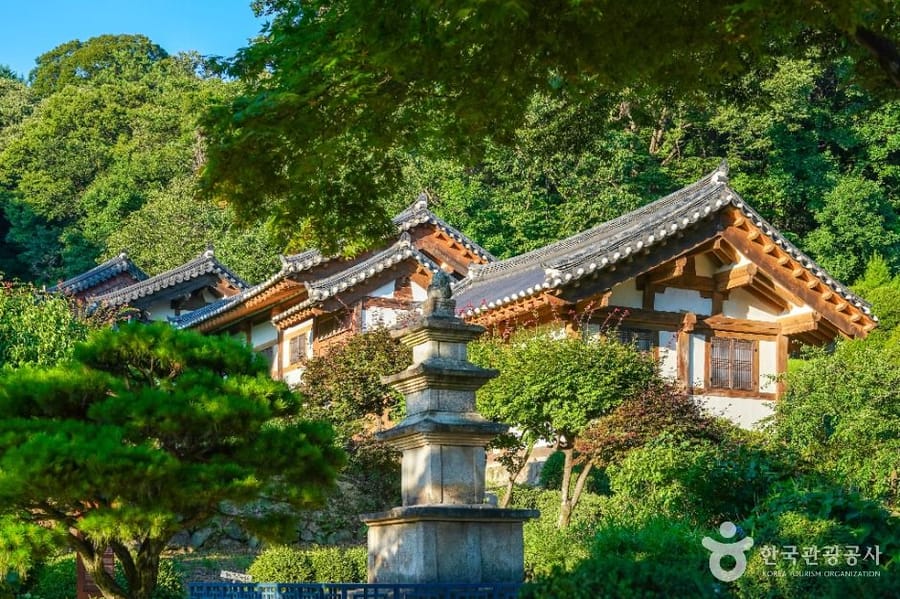
Buseoksa Temple
浮石寺- Era
- Founded 676 · 통일신라
- Sect
- 조계종
- Feature
- UNESCO World Heritage, Thousand-Year-Old Temple
345 Buseoksa-ro, Buseok-myeon, Yeongju City, North Gyeongsang Province
Founded 676 · 통일신라조계종
0 visitors
Verify your visit to unlock challenges.
Temple information
Buseoksa Temple was founded by the royal command of King Munmu of Silla in the 16th year of his reign (676 AD) by Uisang, the patriarch of the Haedong Hwaeom Order, and it served as the principal temple of the Hwaeom Order. While the Grand Master (Uisang) was studying in Tang China, he heard news of Emperor Gaozong's invasion of Silla. He reported this to the king and returned to Silla with the intention of unifying national opinion through the principles of Hwaeom that he had cultivated, thereby overcoming internal and external trials. He then founded this temple, which became the birthplace of Hwaeom thought in Korea. The temple is said to have been named Buseoksa (Floating Stone Temple) because there is a large rock west of the main hall that does not touch the rock below it, appearing to float. During the Goryeo Dynasty, it was called Seondal-sa or Heunggyo-sa. According to an ink inscription discovered during disassembly and repair in 1916, Muryangsujeon Hall and other structures were rebuilt in the early Goryeo period. However, they were destroyed by enemy fires in the 7th year of King Gongmin (1358), leading to the reconstruction of Muryangsujeon Hall in the 2nd year of King U (1376) and Josadang Hall in the 3rd year of King U (1377). Within the temple grounds, there are artifacts from the Unified Silla period, including the Stone Lantern in front of Muryangsujeon Hall, a Stone Seated Buddha, a Three-story Stone Pagoda, a flagpole support (dangganjiju), and a stone foundation. From the Goryeo period, there are Muryangsujeon Hall, Josadang Hall, a Clay Seated Buddha, the Josadang murals, Goryeo woodblocks (gakpan), and the Stele of National Preceptor Wonyung. In particular, Muryangsujeon Hall is one of the oldest wooden buildings in Korea, and the Josadang murals are the oldest paintings on a wooden building, currently preserved in the artifact museum. The Seated Buddha enshrined within Muryangsujeon Hall is the finest extant clay sculpture (sosang) in Korea. The well located west of Muryangsujeon Hall is said to be where Uisang's dharma-protecting dragon (hobeopryong) resided.