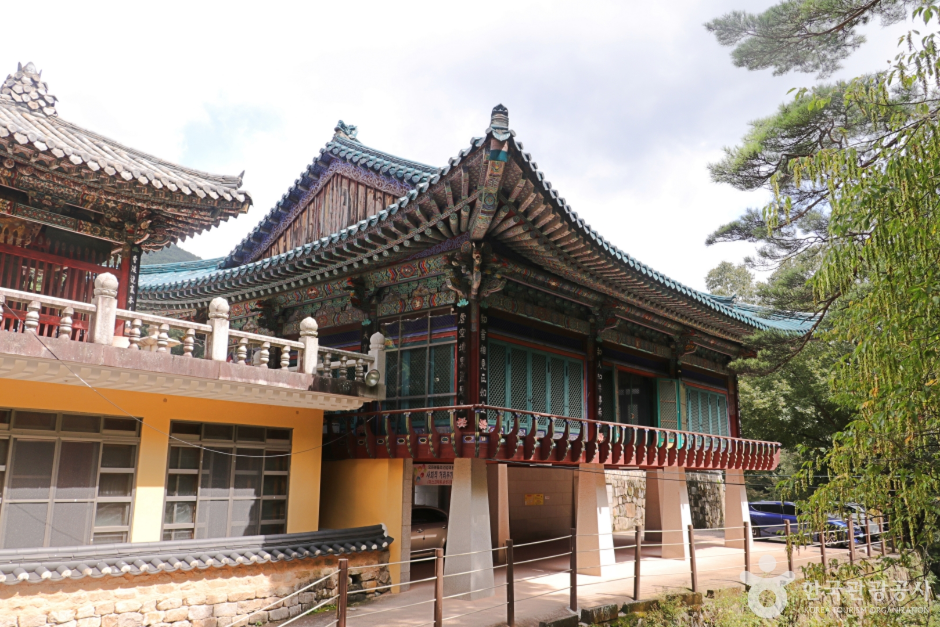
Seoknamsa Temple (Ulsan)
- Era
- Founded 824 · 통일신라
- Sect
- 조계종
- Feature
- Thousand-Year-Old Temple
557 Seoknam-ro Road, Sangbukmyeon Township, Ulju County, Ulsan Metropolitan City
Founded 824 · 통일신라조계종
0 visitors
Verify your visit to unlock challenges.
Temple information
Seoknamsa Temple is located in Deokhyeon-ri, Sangbuk-myeon, Ulju-gun, Ulsan, at the eastern foothills of Gajisan Mountain. It is a branch temple of Tongdosa, the head temple of the 15th district of the Jogye Order of Korean Buddhism. The name Seoknamsa is said to have originated from the fact that Gajisan Mountain was called Seokmyeon-san, and the temple was built on the south side of this mountain. During the reign of King Heondeok (41st monarch of Silla, 809-826 CE), National Preceptor Doui, who first introduced Seon (Zen) Buddhism to Korea, was searching for a sacred and auspicious site. He discovered the Beopunji area of Gajisan Mountain, chose it as the temple site, and then founded the temple to pray for the protection of Silla. After its founding, the temple underwent several renovations and reconstructions but was destroyed during the Japanese invasions of Korea (Imjin War). Afterwards, in 1674 (15th year of King Hyeonjong's reign), with the sponsorship of Kang Ong, the magistrate of Eonyang, monks Takyeong, Jaun, Uicheol, and Taeju rebuilt it. Jinbye, Ssangeon, Ikui, and Seongjin painted the dancheong (traditional ornamental coloring), and at the same time, Buddhist ritual instruments such as bells and drums were prepared. Subsequently, Jeongu, Gagil, Seokmaeng, and others extended the Geuknakjeon Hall, Cheongpungdang Hall, Cheongundang Hall, Cheonghwadang Hall, and Hyanggak, and Seon Master Huicheol built the Myeongbujeon Hall. After that, it fell into disrepair over a long period and was renovated again in 1912 by Ven. Uun. However, it was reduced to ruins during the Korean War, and all remaining traces of the ancient Silla-era temple were utterly destroyed. After being reduced to ruins, Bhikkhuni Inhong was appointed as abbot in 1957. She first renovated and rebuilt the Daeungjeon Hall, Geuknakjeon Hall, and other auxiliary facilities, and then newly constructed the Jonggak (Bell Pavilion), Chimgyeru Pavilion, Simgumdang Hall, and so on, completely transforming the appearance of the temple. Among the existing temple buildings, there are approximately 30 structures, including Daeungjeon Hall, Geuknakjeon Hall, Gangseondang Hall, Josajeon Hall, and Simgumdang Hall. Notable among them are the Daeungjeon Hall built in the 3rd year of King Sunjo's reign (1803) and the Geuknakjeon Hall built in 1791 (15th year of King Jeongjo's reign). In addition to these, cultural heritage items include Seoknamsa Budo (stupa), Treasure No. 369, which is believed to be the stupa of National Preceptor Doui; the Three-story Stone Pagoda, Gyeongsangnam-do Tangible Cultural Heritage No. 22; and a prickly ash tree trough and a stone trough from the early Joseon Dynasty.