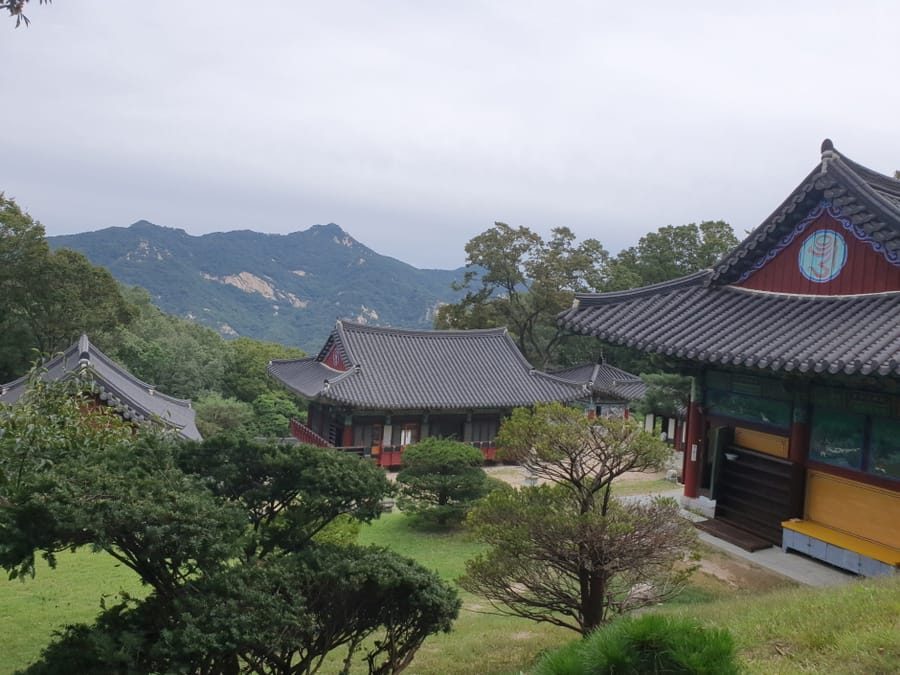
Hakrimsa Temple (Nowon)

Hakrimsa Temple (Nowon)鶴林寺

241 Deokneung-ro 129ga-gil, Nowon-gu, Seoul

Founded 671 · 삼국시대

조계종

Hakrimsa Temple (Nowon) is a branch temple of Jogyesa Temple, which is the head temple of the Jogye Order of Korean Buddhism's direct jurisdiction diocese. It was founded by Wonhyo in 671 (the 11th year of King Munmu's reign). During the reign of King Gongmin of Goryeo, Naong resided here and practiced asceticism. However, it was destroyed by fire during the Jeongyu War in 1597 (the 30th year of King Seonjo's reign) and was rebuilt by Mugong in 1624 (the 2nd year of King Injo's reign). In 1780 (the 4th year of King Jeongjo's reign), Choe Baek and Gyejing rebuilt it and applied dancheong (traditional colorful patterns), and in 1830 (the 30th year of King Sunjo's reign), Chucham renovated it. Thereafter, in 1880 (the 17th year of King Gojong's reign), Yeongseong and Gyeongseon rebuilt it with royal funds arranged by Judge Ha Do-il, and in April 1918, Abbot Geumun rebuilt it. In 1950, some buildings were destroyed during the Korean War (June 25th), but Dowon initiated a temple construction project, greatly enhancing the temple's status. Subsequently, in 1985, the Daeungjeon (Main Buddha Hall), Obaeknahanjeon (Hall of Five Hundred Arhats), and Seolbeopjeon (Sermon Hall) were newly built. It is famous as an arhat sanctuary. Its buildings include the Daeungjeon, Obaeknahanjeon, Samseonggak (Hall of Three Sages), and Yaksajeon (Medicine Buddha Hall). Inside the Obaeknahanjeon is a Stone Seated Triad of Bhaisajyaguru Buddha, designated as Seoul Metropolitan Tangible Cultural Heritage (currently Tangible Cultural Heritage) in 2012, and inside the Yaksajeon is a Stone Seated Buddha, designated as Seoul Metropolitan Cultural Heritage Material (currently Cultural Heritage Material) in 2006. Furthermore, enshrined in the Daeungjeon are a Painting of a Thousand Buddhas, a Guardian Deities painting, and a Ksitigarbha Bodhisattva painting, centered around the main altarpiece. In the Samseonggak, there are paintings of the Seven Stars, the Mountain Spirit, and the Solitary Saint. Among its artifacts are the Hakrimsa Sambul Gwaebuldo (Painting of the Three Bodies of Buddha), designated as Seoul Metropolitan Tangible Cultural Heritage in 2006, and two bell-shaped stone stupas.