Yeongguksa
永國寺- Era
- Founded 668 · 통일신라
- Sect
- 조계종
- Feature
- Thousand-Year-Old Temple
225-35 Yeonggukdong-gil, Yangsan-myeon, Yeongdong County, Chungcheongbuk-do
Founded 668 · 통일신라조계종
0 visitors
Verify your visit to unlock challenges.
Temple information
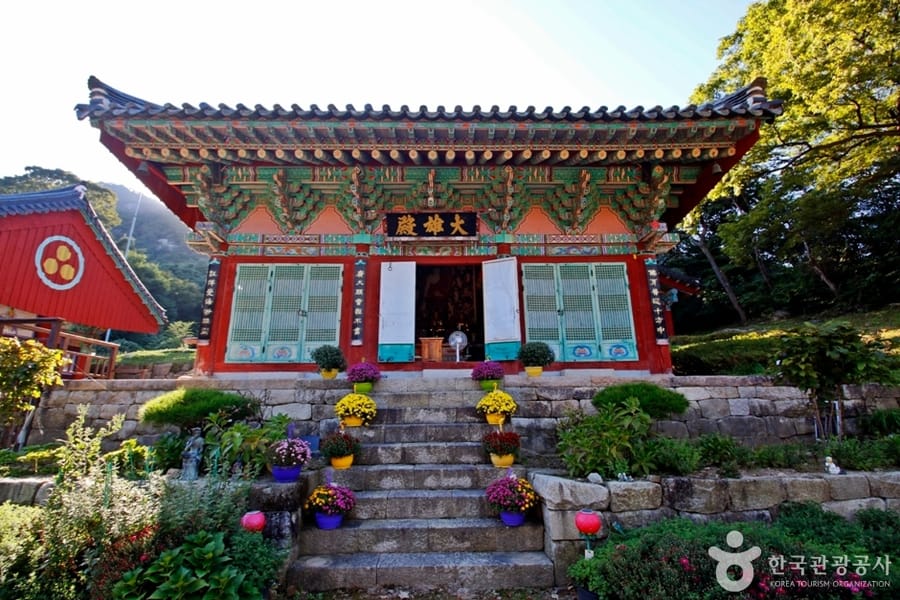
Youngguksa Temple, the first of the eight scenic spots of Yangsan in Yeongdong, Chungcheongbuk-do, is located on Cheontaesan Mountain (715m above sea level), one of the 100 famous mountains, renowned for its outstanding natural scenery and rocky ridge hikes. Following the hiking trail from the entrance of Cheontaesan Mountain, you reach a wide basin. Two valleys flow along the edge of the basin, merging to form a three-tiered waterfall. This water forms a valley, and a path leading to Youngguksa Temple follows that valley. Youngguksa Temple is situated on the eastward-facing slope in the southwest of this basin. It is located on a wide plain deep within Cheontaesan Mountain, offering a very beautiful surrounding landscape. Youngguksa Temple is presumed to have been founded in the 8th year of King Munmu of Silla (668 CE) and rebuilt in the 12th century during the reign of King Myeongjong of Goryeo by National Preceptor Won-gak, who succeeded the Cheontaejong (Tiantai school) founded by National Preceptor Uicheon. During the reign of King Gojong of Goryeo, by royal command, new pagodas, stupas, and a main hall (Geumdang) were built, and the temple was renamed Gukcheongsa. Later, King Gongmin, seeking refuge from the Red Turban Invasion, prayed here for national peace and prosperity. As the nation overcame its crisis and achieved peace, the temple was renamed Youngguksa. It prospered until the early Joseon Dynasty, but its influence waned due to Joseon's anti-Buddhist policies. It was rebuilt by Joo-bong in 1934 and continues to exist today. Youngguksa Temple houses several treasures, including the stele for National Preceptor Won-gak, the Youngguksa Stupa, the three-story stone pagoda in front of the Daeungjeon Hall, and the three-story stone pagoda on Mangtapbong Peak. Additionally, local tangible cultural properties include the Daeungjeon Hall, a bell-shaped stupa (seokjonghyeongbudo), and a spherical stupa (wonguhyeongbudo). Existing buildings, besides the Daeungjeon Hall, include living quarters (yosa), a mountain spirit shrine (sansingak), and a pavilion (nugak), with Gyehwolam as an affiliated hermitage. There is also a magnificent ginkgo tree at Youngguksa Temple that has stood guard over this mountain for over 1,000 years. It stands about 31m tall with a circumference of approximately 11m, and one of its branches has rooted into the ground, growing like an independent tree, designated as a natural monument. Currently, Youngguksa Temple offers a "Happy Journey for Myself" Templestay program, a traditional cultural experience where participants can experience the daily life of a practitioner in a mountain temple where 1,700 years of Korean Buddhist history and culture are alive and breathing. For those who wish to participate in a Templestay but find it difficult to stay overnight, or for foreigners who want to experience Korean Buddhist culture in a short time, there are day-trip Templestays, as well as 1-night, 2-day experiential Templestays at Cheontaesan Youngguksa Temple to reflect on oneself and discover a new self. Furthermore, there are relaxation programs where you can stay and rest at the mountain temple for your desired period.