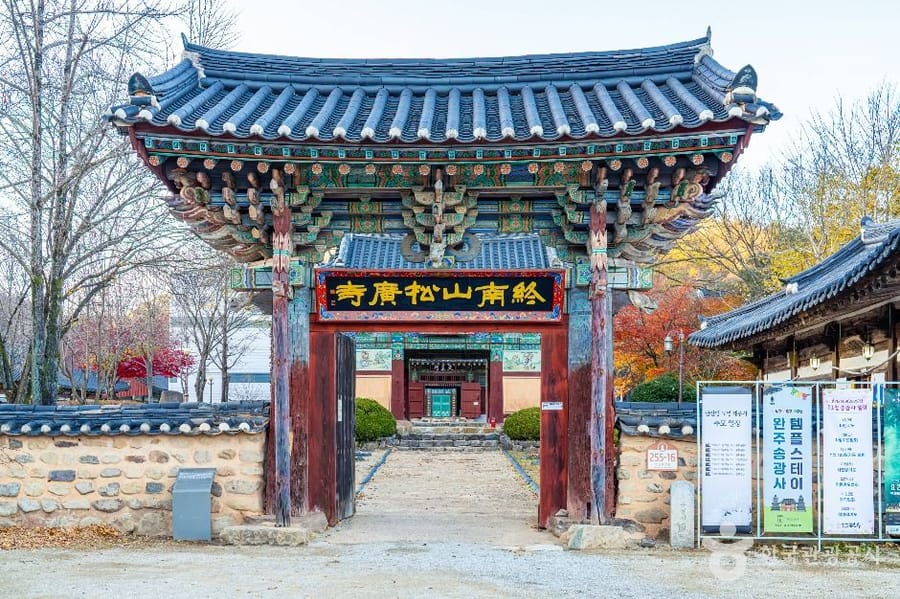
Songgwangsa Temple (Wanju)

Songgwangsa Temple (Wanju)松廣寺

255-16 Songgwangsuman-ro, Soyang-myeon, Wanju-gun, Jeonbuk Special Self-Governing Province

Founded 867 · 통일신라

조계종

Book Templestay

Songgwangsa Temple is located on Jongnamsan Mountain in Wanju-gun, Jeollabuk-do. Songgwangsa first appears in historical records at the end of the Unified Silla period. While Seon Master Chejing was on his way to study in China after practicing at Eokseongsa Temple in Seoraksan Mountain, he heard rumors that Baeknyeonsa Temple was a sacred site and stayed there for a while. According to tradition, Baeknyeonsa Temple was built next to a miraculous spring on the south side of Jongnamsan Mountain. After Seon Master Chejing returned to Korea, he renamed Baeknyeonsa Temple to Songgwangsa Temple. It was later completely destroyed during the Imjin War and the Jeongyujaeran War, and from 1636, Master Byeogam Gakseong devoted great effort to extensively rebuild it into its current temple complex. Songgwangsa Temple consists of buildings such as Daeungjeon (Main Buddha Hall), Jijangjeon (Ksitigarbha Hall), Yaksajeon (Medicine Buddha Hall), Gwaneumjeon (Avalokitesvara Hall), Sipjagak, Geumgangmun (Diamond Gate), Hyangnojeon, and Jeokmukdang. Cultural heritage items within the temple grounds include the Bell Pavilion of Songgwangsa Temple in Wanju, the Clay Four Heavenly Kings of Songgwangsa Temple in Wanju, the Bronze Bell of Songgwangsa Temple, and the Stele of Songgwangsa Temple. Experiential programs include Templestay and the Buddhist Academy. The Buddhist Academy was established to broadly explore Buddhist thought based on a correct understanding of Buddhism and to mature as Buddhist individuals. The Buddhist Academy is divided into Semester 1 and Semester 2, with lectures conducted for 16 weeks per semester. Through these lectures, participants can take courses such as Understanding Early Buddhism, Understanding Mahayana Buddhism, and a close reading of the Mūlamadhyamakakārikā (Treatise on the Middle Way). Templestay consists of one-day, experiential, and relaxation types. Through morning chanting, 108 prostrations, Zen meditation, and tea conversations with monks, one can momentarily set aside a mind and spirit always full of thoughts, and take time to quietly embrace and understand oneself.