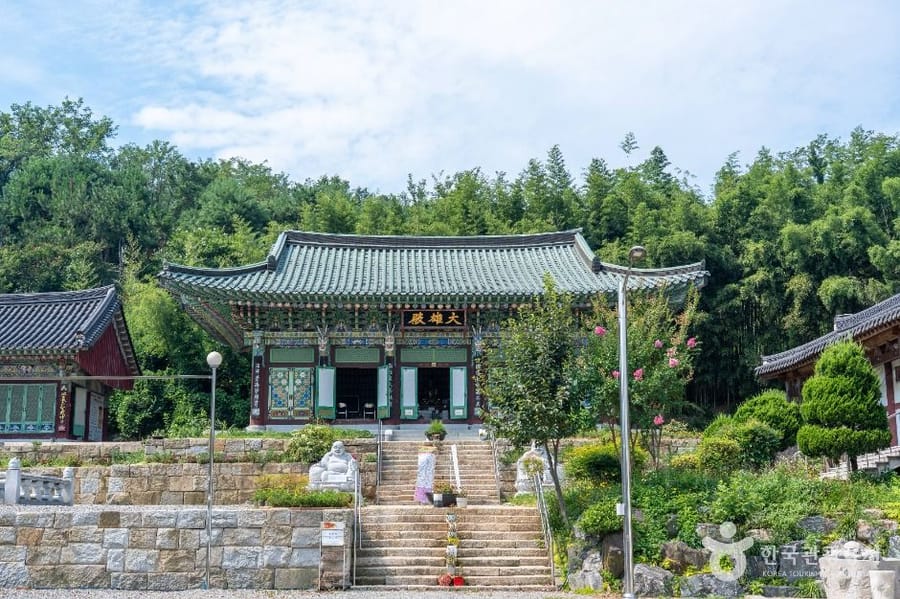
Sudosa Temple (Pyeongtaek)
- Era
- Founded 852 · 통일신라
- Sect
- 조계종
- Feature
- Temple Cuisine Specialty, Thousand-Year-Old Temple
None
Founded 852 · 통일신라조계종
0 visitors
Verify your visit to unlock challenges.
Temple information
Sudo Temple was founded by Master Yeomgeo in 852 (the 14th year of King Munseong of Silla). However, since this is the place where Great Master Wonhyo attained enlightenment after drinking water from a skull in 661 (the 1st year of King Munmu), it is presumed that a small hermitage existed here even before Master Yeomgeo founded the temple. According to the Samguk Yusa, while Great Master Wonhyo was on his way to study in Tang China, he stayed for a day in a rock cave near Sudo Temple. During the night, feeling thirsty, he groped around and found what seemed to be water in a gourd dipper, which he drank refreshingly. However, the next day upon waking, he saw that the dipper from which he had drunk water was a skull, and he vomited. Thereupon, Great Master Wonhyo realized that everything originates from the mind and abandoned his plan to study in Tang China, leaving behind the enlightenment verse: "When the mind arises, myriad phenomena arise; when the mind ceases, myriad phenomena cease." After its founding, Sudo Temple prospered greatly, but due to rampant bandits, severe looting, and even the abduction of monks, the temple became empty, and it was also abandoned after a landslide occurred. Since no historical records from that time until the mid-Joseon period survive, its detailed history is unknown. Sudo Temple's Daeungjeon (Main Hall) was burned down during the Imjin War and later rebuilt, only to be abandoned again in 1911. It is said that in the 1960s, Master Choi Yeong-seok moved the temple approximately 100 meters south from its old site and re-established the current temple grounds. Currently, Sudo Temple features the Daeungjeon (Main Hall) as its center, along with the Myeongbujeon (Hall of Judgment), Sansingak (Mountain Spirit Shrine), a dedicated Templestay facility (Yaksa Hall), a traditional temple food learning and experience center, a thatched-roof house, and a two-story monks' living quarters.